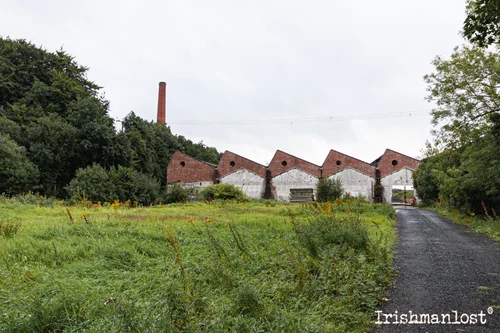
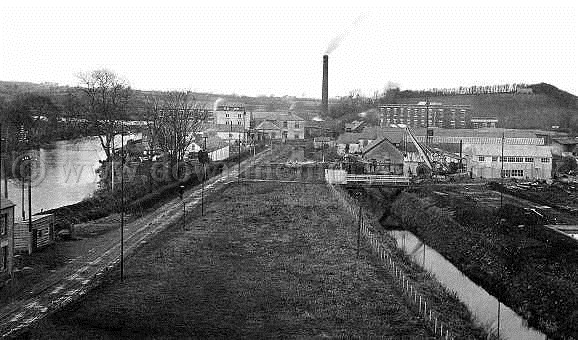
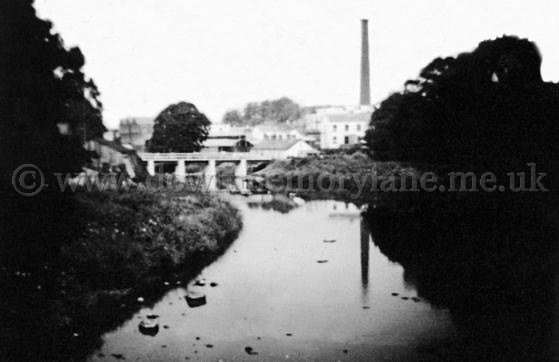
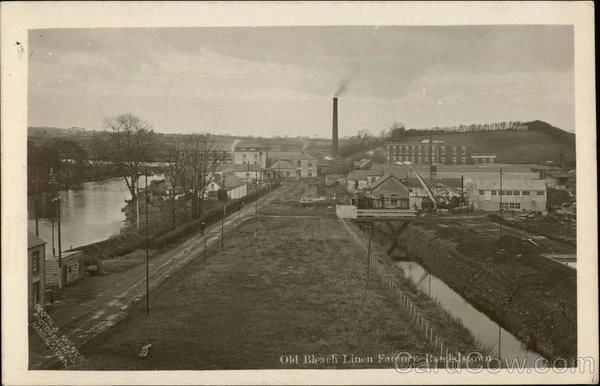
For generations, this was the outline people walked towards in the morning. The chimney rose above a working world beside the River Maine: looms, bleaching, dyeing, finishing, cutting, stitching, packing and dispatch.
They did not only make linen. Their work helped build Randalstown’s foundation and carried its name into homes, ships, aircraft and royal rooms around the world.
Enlarge photographThe landmarkThe chimney above the worksOld Bleach site photographed in 2008 · Irishman Lost
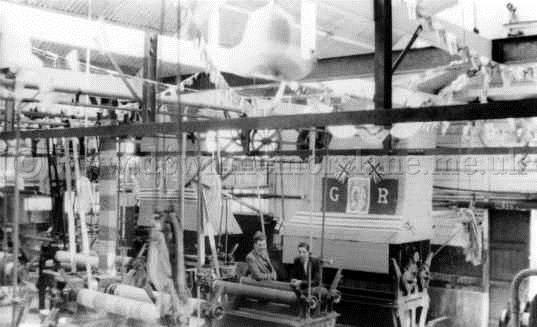
Open photographThe works in 1910The River Maine, factory buildings and smoking chimney.Open photographThe outline workers knewA familiar sight on the walk towards work.Open photographInside, June 1937The machinery is known. The department is not identified in the surviving caption.
A view preserved on a postcard
The factory beside the water
The supplied postcard identifies the Old Bleach Linen Factory at Randalstown. Its date is not recorded. The source watermark is retained.
Enlarge photographOld Bleach Linen Factory, Randalstown. Date unknown. Source watermark: CardCow.com; supplied for this archive.
Through the works
01Design & weaveDamasks, plain cloth and specialist orders take shape on the looms.
02Bleach & finishCloth is bleached, coloured, dyed or hand-painted and given its finish.
03Inspect & mendFaults are found and skilled hands darn imperfections in the cloth.
04Cut & stitchLater-stage workers turn cloth into finished household linen.
05Pack & dispatchFinished orders leave Randalstown for customers far beyond it.
Historic works photographs: Down Memory Lane. Chimney photograph: Irishman Lost. The historic works photographs are shown as supplied.
02
A factory and a town
The Old Bleach story
Founded in 1864, the company became Randalstown’s largest employer. Its history was industrial, but its legacy is personal: shifts, skills, friendships, jokes, pay packets and families whose lives crossed inside the same walls.
Charles James Webb establishes the company
The Quaker-founded firm builds its name on fine household and dress linen.
Design becomes part of the name
Old Bleach is among the linen firms registering designs with the Board of Trade from the middle of the decade.
Queen Mary’s Dolls’ House
Every piece of linen in the famous miniature house is supplied by Old Bleach.
A wider design range
The company expands its furnishing fabrics, with surviving examples now held in major museum collections.
The weaving looms stop
The weaving operation ends, existing orders are honoured and production gradually winds down. Later stages of manufacture continue after the looms fall quiet.
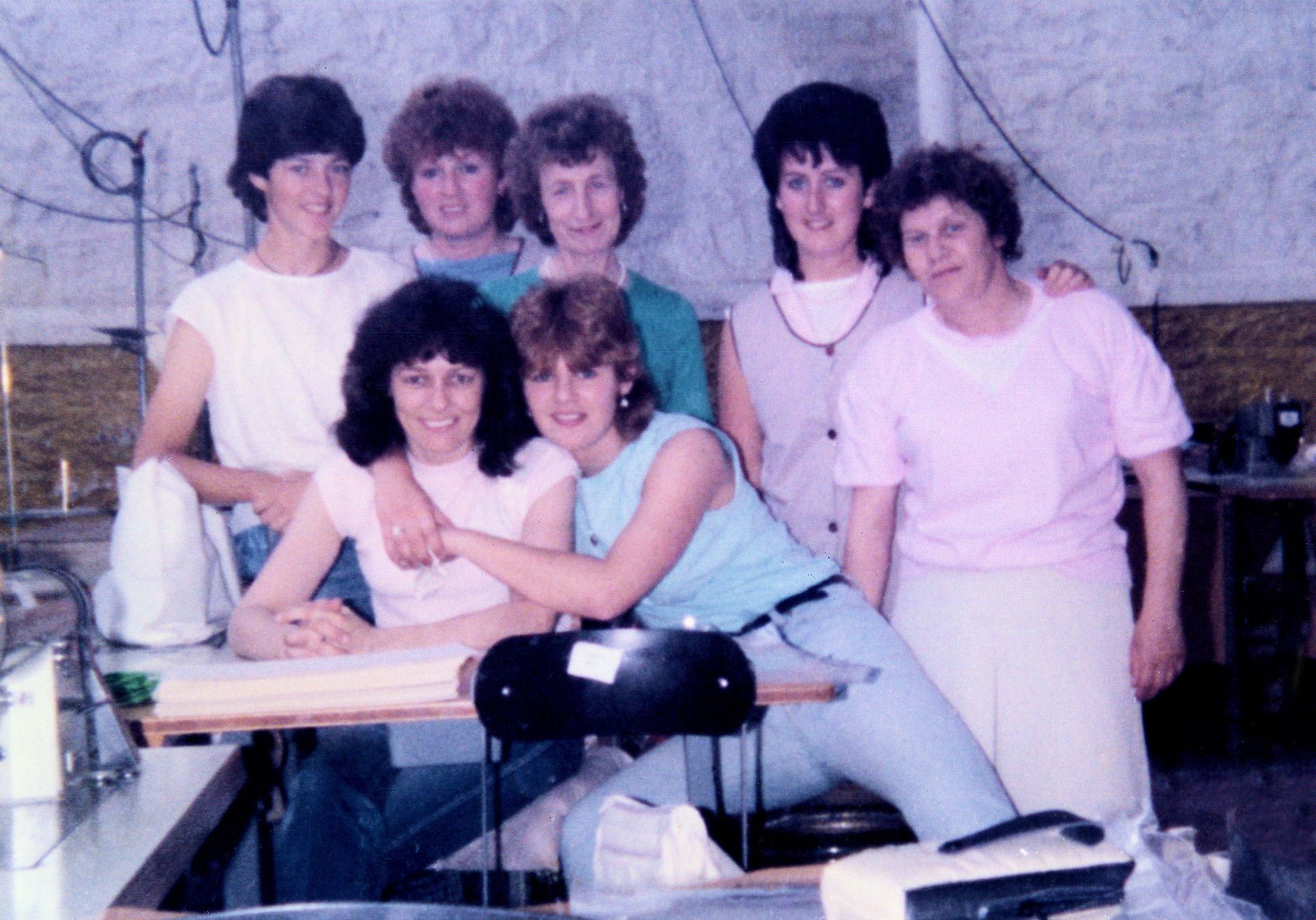
The Stitching Room is still at work
Photographs of Kathleen Letters and her colleagues show women still stitching, finishing and sharing their working days during the factory’s final period.
The rhythm of a working day
7:45First horn
7:55Second horn
8:00Work begins
10:00Tea break
1:00Half-hour lunch
Memories of the working day
Work, wages and getting the linen out
The working-day times above come from Samuel Ramsay’s Living Linen interview. His recollections describe one worker’s experience, rather than a timetable for every period of the factory’s history.
More than linen
Carpets and heavy cloth
In his interview, Samuel Ramsay explained that Old Bleach also wove jute for sacking and carpets on special looms. He identified the old carpet-factory site as the location later occupied by Dorma Old Bleach. The record does not establish where that sat within the earlier factory complex.
A Down Memory Lane account records Old Bleach parcels stacked at Randalstown Post Office and linen being carried from the mill to the railway station by electric lorry. That is not as modern as it sounds: British businesses were using battery-electric delivery vehicles by 1919. The date and model of the Old Bleach vehicle are not recorded in the account.
The surviving 1935 sales bill also states that qualifying parcels could be sent carriage-paid by post or rail.
Samuel Ramsay said weavers were paid according to output, based on the amount of cloth woven. He also received a little extra for locking up and checking the machinery at night. The interview does not provide the rates paid, so this page does not turn those memories into an unsupported wage figure.
The chimney can mark the place. Family records preserve the people, their departments, the work they did and the memories that did not appear in company reports.
This page distinguishes documented dates from family interpretation. It does not describe 1980 as a single closure date because surviving 1982 Stitching Room photographs show later-stage work continuing.